
Key Takeaways
- Understand the key differences between Industrial Grade Nickel Sulphate and Battery Grade Nickel Sulphate.
- Choosing the right Nickel Sulphate grade is crucial for process compatibility and application-specific needs.
- Industrial Grade Nickel Sulphate is suitable for general industrial applications like electroplating and catalyst production.
- Battery Grade Nickel Sulphate requires tighter purity controls to meet specific battery production standards.
- Buyers should verify chemical specifications and impurities before purchasing Nickel Sulphate to avoid mismatches.
Muqeet Marketing, leading supplier of Nickel Sulphate for industrial applications.
Nickel sulphate may look like a straightforward chemical purchase, but the required grade can change the entire buying specification. For B2B buyers, the main distinction between Industrial Grade Nickel Sulphate and Battery Grade Nickel Sulphate comes down to purity requirements, impurity control, application sensitivity, and documentation. Choosing the right grade starts with understanding what your process actually requires.
What Is Industrial Grade Nickel Sulphate?
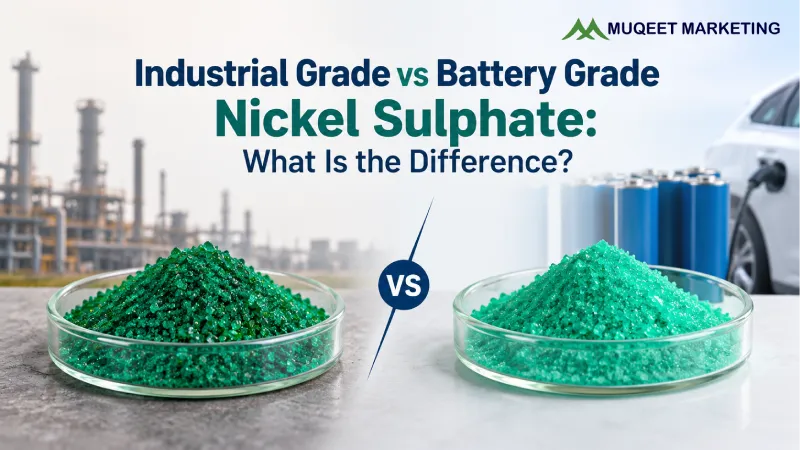
Industrial Grade Nickel Sulphate is used where nickel sulphate must perform reliably in general industrial processes without the extremely tight trace-impurity limits associated with advanced battery precursor production. Common uses include electroplating, catalyst production, pigments, chemical processing, and other industrial applications.
Muqeet Marketing’s current Nickel Sulphate product page lists an industrial-grade product with the chemical formula NiSO₄, a minimum purity of 98%, a green crystalline solid or powder appearance, water solubility, and a pH range of 5.0–7.0 in a 1% aqueous solution. The page also identifies electroplating, battery manufacturing, catalyst production, and fertilizers among its applications.
For buyers comparing suppliers, Industrial Grade Nickel Sulphate should be evaluated against the actual operating requirements of the intended process rather than by grade name alone.
What Is Battery Grade Nickel Sulphate?
Battery Grade Nickel Sulphate is intended for battery-material supply chains where trace contaminants can affect downstream cathode precursor chemistry. Research on battery-grade nickel sulphate production places strong emphasis on high purity and the removal or control of impurities such as magnesium, cobalt, sodium, and calcium.
In practice, battery-related procurement normally requires a more detailed chemical specification than a basic overall purity figure. Buyers may need limits for individual metallic impurities, moisture or hydration form, consistency between batches, and analytical documentation based on the requirements of their cathode or precursor process.
This means Battery Grade Nickel Sulphate should not be selected simply because a material is described as “high purity.” The product has to match the specific battery manufacturer’s or precursor producer’s acceptance criteria.
Industrial Grade vs Battery Grade Nickel Sulphate
The most useful way to compare the two is by looking at what matters to the buyer during qualification.
| Comparison Point | Industrial Grade | Battery Grade |
|---|---|---|
| Primary focus | Suitability for general industrial processing | Suitability for battery precursor and cathode-related processes |
| Purity approach | Overall assay may be the main purchasing parameter | High purity plus tighter trace-impurity control |
| Impurity requirements | Depend on the industrial application | Typically much more application-sensitive |
| Common applications | Electroplating, catalysts, pigments and chemical processing | Battery-material and cathode precursor production |
| Buyer documentation | Product specification and standard quality documents | More detailed impurity analysis and customer-specific qualification may be required |
| Selection basis | Process compatibility and required industrial specification | Battery chemistry, precursor process and defined impurity limits |
The table shows why the words “industrial grade” and “battery grade” cannot be treated as interchangeable purchasing labels. The correct choice depends on the downstream process and the specification agreed between buyer and supplier.
Why Purity Alone Does Not Tell the Full Story
A buyer may see two nickel sulphate products with relatively high assay values and assume they are suitable for the same use. That can be misleading. Battery Grade Nickel Sulphate is especially sensitive to the type and concentration of unwanted elements, not only the headline purity percentage.
Scientific research on battery-grade nickel sulphate highlights impurity management as a central part of purification because certain elements can become incorporated into nickel sulphate crystals and may affect later battery-material processing.
For a general industrial process, the acceptable impurity profile may be different. This is why buyers sourcing Industrial Grade Nickel Sulphate should compare the supplier’s specification with their own process limits instead of applying battery-industry requirements unnecessarily.
Which Grade Should a B2B Buyer Choose?
Start with the end use. If the material is being purchased for electroplating, catalyst production, fertilizer-related use, or another standard industrial process, the required specification may align with an industrial grade. If it will enter a lithium-ion battery cathode or precursor supply chain, a battery-specific specification will normally be required.
A reliable Nickel Sulphate Supplier in India should be able to discuss the intended application before the buyer finalizes the material specification. Buyers should also avoid assuming that every product marketed for a battery-related application automatically meets a particular battery-grade standard.
Before placing a bulk order, verify the following points:
- ✔ Confirm the exact intended application and process conditions.
- ✔ Check the required nickel sulphate form and chemical specification.
- ✔ Review overall purity together with limits for critical impurities.
- ✔ Ask what batch-level analytical or quality documentation is available.
- ✔ Confirm packaging and storage requirements for your operation.
- ✔ For battery applications, compare the supplier specification directly with your approved material standard.
These checks make qualification more practical and reduce the risk of purchasing a grade that does not match the production requirement.
Why Supplier Communication Matters
Working with a Nickel Sulphate Supplier in India is not only about locating available material. Industrial buyers need clear product specifications, consistent communication, and a supplier who understands that different processes may call for different acceptance limits.
At Muqeet Marketing, our current Nickel Sulphate page identifies the supplied material as industrial-grade and lists a minimum purity of 98%. For buyers with a specific technical requirement, discussing the application and required specification before ordering is the right approach.
Why Choose Us
Muqeet Marketing supplies Nickel Sulphate from Surat for industrial requirements and serves buyers across multiple Indian states and cities. Our product page provides clear industrial-grade specifications and identifies applications including electroplating, battery manufacturing, catalyst production, and fertilizers. Businesses looking for a Nickel Sulphate Supplier in India can contact our team with their required application, quantity, and specification so that the product requirement can be reviewed before purchase.
Conclusion
The difference between industrial and battery grades is mainly about how tightly the material must be controlled for its intended use. Industrial material may be suitable for a broad range of processing applications, while battery-grade material generally requires much stricter attention to trace impurities and downstream qualification. Before selecting either grade, buyers should review the complete chemical specification rather than relying only on a grade label. Muqeet Marketing currently lists industrial-grade Nickel Sulphate, so buyers with specialized battery requirements should confirm their required parameters directly before procurement.
Looking for a dependable Nickel Sulphate Supplier in India for your industrial requirement? Contact Muqeet Marketing with your application, required quantity, and technical specification. Call +91 9825115698 or email muqeetmarketing@yahoo.com to discuss your Nickel Sulphate requirement and place a supply enquiry.